
This comprehensive synthesis integrates the three sources into a coherent narrative of the MAD Theory, explaining the biological foundations, character profiles, and the mechanism of depression in the modern world.
I. The Core Philosophy: A Biological Model of Function
The MAD Theory is a theoretical framework that conceptualizes mental illness not as a “weakness of character,” but as the overdriving of physical apparatus—the neurons—and the subsequent activation of a biological safety mechanism. Unlike traditional psychiatry, which often focuses on localized brain lesions or neurotransmitter imbalances, this theory focuses on a fundamental, non-localized functional change: how a single neuron responds to repetitive stimulation.
II. The Three Neuronal Response Types (M, A, D)
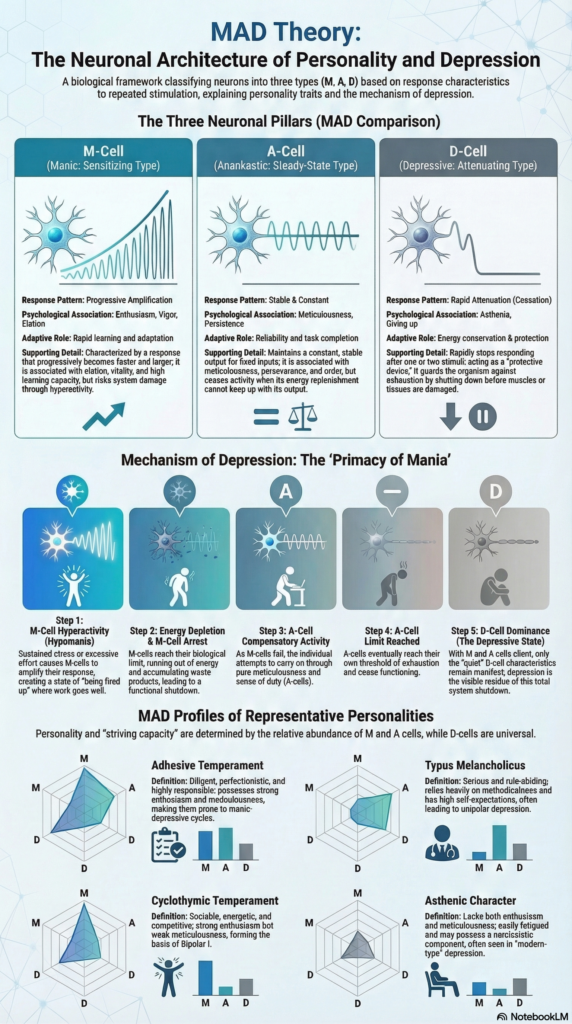
The theory classifies neurons into three types based on their behavioral patterns when stimulated repeatedly:
- M-cells (Manic): These neurons progressively amplify their response (sensitization/potentiation). They are associated with enthusiasm, elation, and the feeling of “getting into a groove”. While adaptive for learning, they carry the risk of damaging the system if the response becomes too large.
- A-cells (Anankastic): These neurons provide a stable, constant response. They represent the biological basis for meticulousness, persistence, and adherence to rules. They guarantee reliable output but cease activity if energy replenishment and waste removal cannot keep up with the load.
- D-cells (Depressive): These neurons respond briefly and then rapidly attenuate, becoming unresponsive. They are the “quietest” cells and make up the great majority of neurons in the human brain. Their role is a “protective device”; by stopping the signal before a muscle becomes fatigued or a tendon ruptures, they guard the organism against total exhaustion.
III. Premorbid Character: The “MAD Profile”
An individual’s personality (premorbid character) is determined by the distribution and ratio of these three cell types in their brain.
- Adhesive Temperament (M-many, A-many, D-many): Diligent, perfectionist, and strong in both enthusiasm and responsibility. This type is prone to manic-depressive illness because both M and A components can reach hyperactivity.
- Typus Melancholicus (M-few, A-many, D-many): Serious and methodical, with low enthusiasm (M) from the start. They rely primarily on their A-component and are prone to unipolar depression.
- Cyclothymic Temperament (M-many, A-few, D-many): Sociable and energetic, with a predominant M-component and weak A-component. This forms the basis for Bipolar I disorder.
- Asthenic Character (M-few, A-few, D-many): Lacking in both enthusiasm and meticulousness. This “quiet” profile is actually the biological “standard” for humans; M-high or A-high individuals are the exceptions.
IV. The Mechanism of Onset: The “Primacy of Mania”
The central thesis of the MAD Theory is the “Primacy of Mania” (PM) hypothesis: depression never exists in isolation; it is always preceded by a state of neuronal hyperactivity.
- Phase 1: Hyperactivity (Manic State): Sustained stress or excessive effort drives M-cells to amplify their response. The person feels “fired up” or that work is going exceptionally well—biologically, a hypomanic state.
- Phase 2: Functional Arrest (Burnout): Neuronal energy is finite. Eventually, M-cells reach their limit, run out of fuel, and accumulate waste, leading to a sudden cessation of activity.
- Phase 3: Compensatory Effort: When M-cells go down, the individual tries to carry on using A-cells (relying on sheer responsibility and methodicalness).
- Phase 4: Completion of Depression: If the load continues, A-cells also hit their limit and shut down. With M and A “subtracted” from the foreground, only the characteristics of the quiet D-cells remain. This “residual” state—characterized by asthenia and negative mood—is the essence of depression.
V. Modern Society: The Trap of “Brain Labor”
The theory explains the modern increase in depression through the shift in labor forms.
- Physical Labor (The Past): Muscles act as a safety valve. Fatigue or injury (like an Achilles rupture) forces the body to rest before the neurons burn out.
- Brain Labor (The Present): Working on computers produces no clear physical damage. There is no “physical stopper,” allowing neurons (M and A cells) to be overworked to their absolute biological limits until they hit functional arrest.
VI. Integration with “Time Delay Theory”
The MAD Theory (which operates on a scale of months) is complementary to the Time Delay Theory (which operates on a scale of milliseconds).
- In Mania: M-cell overactivity leads to an over-generation of prediction signals, enhancing the “sense of agency” and feelings of omnipotence.
- In Depression: The cessation of M and A cells weakens prediction signals. This causes a loss of the “sense of agency,” where the patient feels they are no longer the one moving their own body.
VII. Principles of Treatment and Recovery
The MAD Theory provides a clear, biological logic for recovery:
- The Importance of Waiting: The essence of treatment is “resting over time” (typically ~3 months) until the arrested M and A cells recover their function.
- Pharmacotherapy:
- Mood Stabilizers (anticonvulsants) prevent M-cells from “striving” until they burn out by setting a ceiling on excitement.
- SSRIs supplement the serotonin that has decreased as a result (not necessarily the cause) of neuronal functional arrest.
- Prevention: The goal is to transform a personality that “pushes to the limit” into one that distributes effort (e.g., dividing a mountain of work over months rather than doing it all at once).
Conclusion
Ultimately, the MAD Theory views depression as a safety mechanism—a forced shutdown of the organism to prevent total destruction. By understanding the temporal and biological structure of “living,” patients can learn to navigate their lives without imposing unreasonable demands on their neuronal apparatus.